Heat treatment simulation: Induction Hardening
Induction hardening is a heat treatment technique that heats the component directly from within, exploiting advanced physical principles. This process is particularly effective for selectively hardening specific areas of the part, such as the inner or outer surface, ensuring fully customized treatment. Thanks to the DEFORM software, it is possible to simulate and optimize the entire process, from the initial setup to the prediction of the final result.
The component is heated by a copper coil that generates an alternating electromagnetic field. This induces eddy currents in the material, causing a temperature rise due to internal electrical resistance. The heat generated brings the component to the desired hardening temperature, which can be precisely defined according to the type of material and the specific requirements of the part.
Fill in the form and discover how DEFORM can transform production processes.
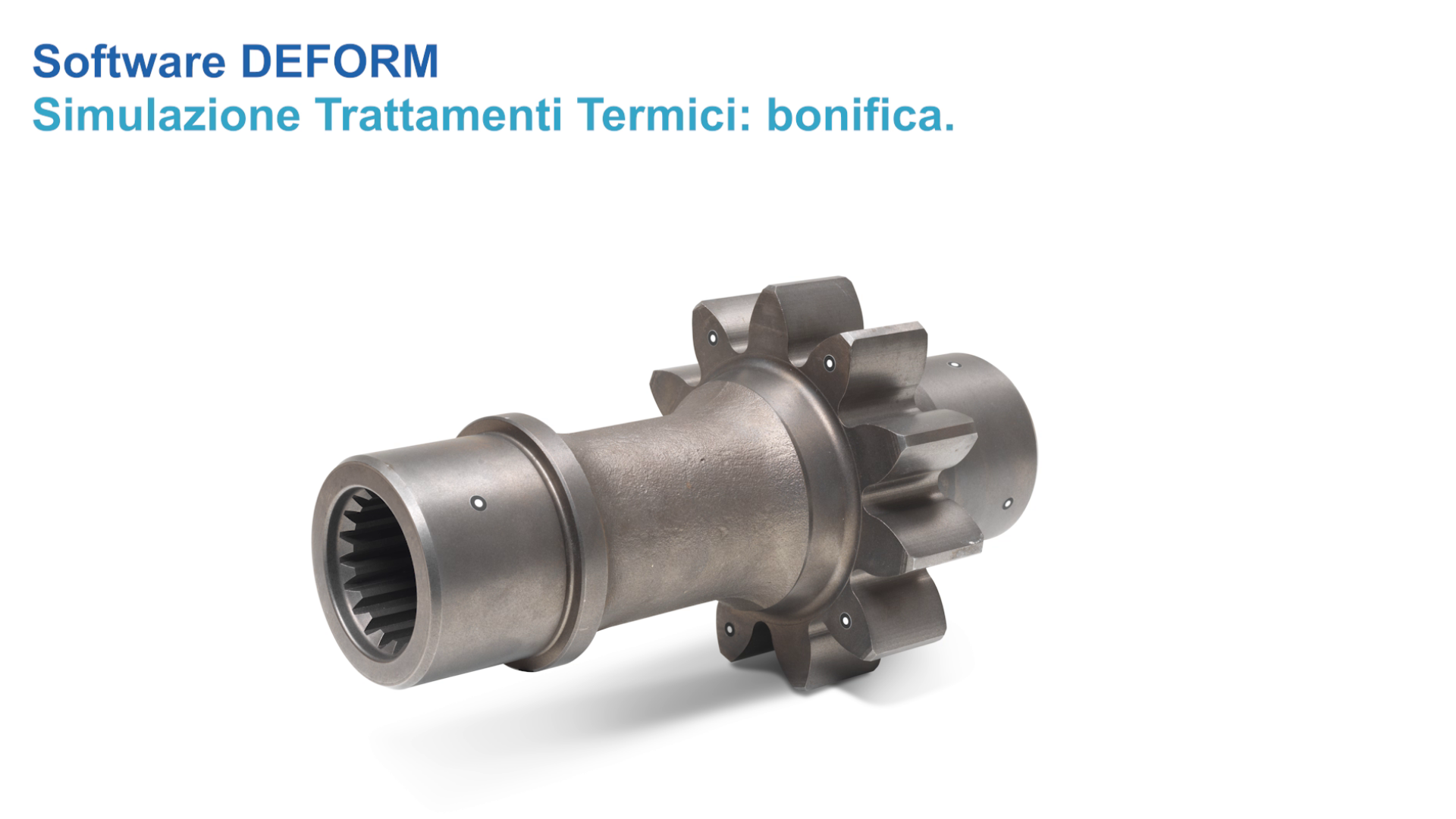
Simulazione Trattamenti Termici: Tempra Induzione
Case study: lorem ipsum
During the process, induction hardening is carried out sequentially. The inductor is moved progressively along the part to heat the desired area, which is then quenched by a spray, rapidly cooling the material to obtain the required hardness. Alternatively, the component can be passed gradually through the inductor, ensuring uniform treatment. For particular geometries, such as shafts, a rotary motion is often required to achieve optimal heat distribution.
One of the main advantages of induction hardening is the speed of the treatment. Extremely short heating and holding times not only speed up the production process, but also reduce the surface oxidation of the component, preserving the quality of the final product. In addition, the process offers a high degree of control over the final characteristics of the part. Through DEFORM, it is possible to precisely determine the ideal ratio between holding time and hardening temperature, tailoring it to the specific materials.
After the hardening process, a low-temperature stress-relieving stage or a tempering step is required to relieve the internal stresses built up during treatment. This stage too can be optimized thanks to accurate simulations that predict the material’s behavior and its response to thermal variations.
Optimize production time and costs: get more information about advanced simulation technologies.
The advantages of using DEFORM in induction hardening
The use of the DEFORM predictive software is a crucial added value for companies that want to innovate and optimize their heat treatment processes. Among the main benefits:
- Accurate prediction of results: the software makes it possible to know the ideal parameters for each treatment in advance, avoiding errors and wasted resources.
- Reduced development times — thanks to simulation, different configurations can be tested virtually, saving valuable time in the design phase.
- Maximum customization — each treatment can be tailored to the specific characteristics of the material and component, ensuring excellent results.
Simulazione Trattamenti Termici: Tempra Induzione
Case study: lorem ipsum
Why choose DEFORM?
- Quality improvement
- Optimization and savings in design
- Improved production
- Increased accuracy
- Ease of use
- Reduced computation times
- Reduction of rejects in production
- Cost savings
What customers say:
The American DEFORM software, dedicated to heat treatment simulation, has been designed and optimized to ensure maximum accuracy, speed and extreme ease of use.
- EXCELLENT ALIGNMENT BETWEEN “SOFTWARE RESULTS” AND “REALITY”DEFORM is the most widely used heat treatment simulation software in the world.
- SAMPLING SUCCESSFUL RIGHT AWAYSimulation makes it possible to identify the defects produced during heat treatments, understand their causes and therefore take the right corrective actions.
For information on purchase, rental or to request a DEMO of the software, or to take advantage of a customized simulation service offered by our technical department, contact us at +39 030 3365383 or fill in the form at the bottom of the page.
References